
Pilot sites
Within the SCALE project, a pilot site is a geographical grouping of partners working together on specific use cases. Each pilot site tests, experiments and implements concrete solutions linked to Cooperative Intelligent Transport Systems (C-ITS), based on local issues and the expertise of the players involved. The project involves a total of 10 European pilot sites.
France has 6, spread across the country, each dedicated to a specific theme:
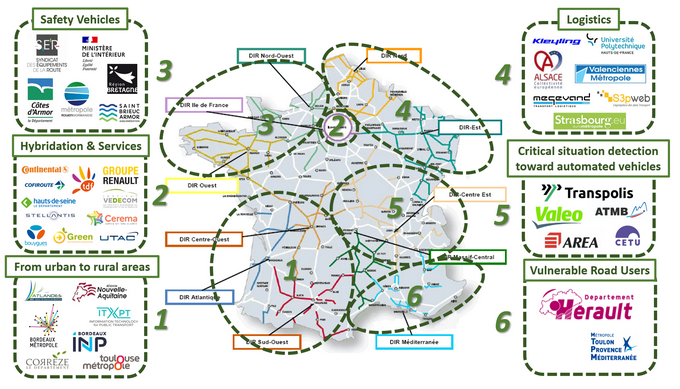
South-East pilot site:
The South-East pilot site focuses on the safety of vulnerable road users, such as pedestrians and cyclists.
Advanced warning systems will be installed at greenway crossings, with intelligent sensors and cameras.
In addition, sensors will be installed on bridges to inform users of tonnage limits and protect these structures from the passage of overweight vehicles.
Patrol vehicles will also be equipped with advanced communication devices, enabling them to locate mobile worksites in real time, and to enhance road safety, as well as that of officers working in the field.
The aim is to make the roads safer for everyone, by reducing the risk of accidents at the most sensitive points on the road network.
Beneficiary partners:
Conseil départemental de l’Hérault, DIR Méditerranée
Associated partners:
Métropole Toulon-Provence-Méditerranée
Main use cases:
Safe cycle routes and greenways
Safe crosswalks, with possible consideration for people with disabilities
Technologies used: Smart sensors, connected cameras, on-board communication devices
Key figures: Installation planned on 3 critical greenway crossings
South-West pilot site:
On this pilot site, the project aims to improve urban and rural mobility, with an emphasis on integrating public and private transport. Dedicated bus lanes, real-time information systems on available parking spaces, and advanced emergency management technologies - particularly in the event of flooding on at-risk roads - will be deployed.
The aim is to make public transport more efficient and accessible, while reducing congestion and improving safety in city centers and suburban areas.
Beneficiary partners:
DIR Sud-Ouest, Bordeaux Métropole, ITXPT, Région Nouvelle Aquitaine
Associated partners:
Atlandes, Conseil départemental de la Corrèze
Main applications:
Crisis management for flooded roads
Bus lanes
Technologies used:
Climate sensors
Traffic management systems
Key figures:
200 km of road network covered
15 dedicated lanes deployed
North-West pilot site:
On this pilot site, the focus is on optimizing road operators vehicles and emergency vehicles too (particularly law enforcements vehicles). New use cases are planned to improve the reactivity of these vehicles, while at the same time enhancing road safety for all road users. The networks concerned are both urban and inter-urban.
The other main objective is to define a technical architecture for the connected vehicle used by law enforcements and road managers. This involves the development of new secure communication protocols to make the equipment interoperable.
Finally, the North West pilot site will consolidate its technical infrastructures and use cases (Road Works Warning, Hazard Local Notifications, Embedded Variable Message Signage) already deployed by some of its partners during previous C-ITS projects.
Beneficiary partners:
DIR Ouest, DIR Nord-Ouest, ministère de l’Intérieur, Conseil départemental des Côtes d’Armor, Syndicat des Equipements de la Route, Métropole Rouen-Normandie
Associated partner:
Région Bretagne
Main use case:
Priority to emergency vehicles
Technologies used:
New secure communication protocols
Key figures:
100 vehicles equipped with OBU on the French Ministry of Interior vehicles’ fleet.
North-East pilot site:
The North-East pilot site focuses on optimizing logistics and truck traffic management.
Thanks to intelligent systems, truck routes can be optimized to reduce operating costs while improving route safety. Advanced sensors will be deployed on infrastructures to monitor road conditions in real time and prevent dangerous situations, such as weather-related risks or overloaded vehicles
Beneficiary partners:
DIR Est, DIR Nord, Kleyling, Université polytechnique Hauts-de-France, Collectivité européenne d’Alsace, Valenciennes Métropole, S3pweb, Eurométropole de Strasbourg
Associated partner:
Megevand Frères
Main use case :
Logistics optimization for freight transport
Technologies employed:
Advanced navigation systems
Intelligent sensors for monitoring road conditions
Key figures:
2 trucks involved in the deployment
Centre-Est pilot site:
LThe Centre-Est pilot site is dedicated to the safety of critical infrastructures, in particular road tunnels, and to the protection of interventions by road operators.
Communication devices will be installed to alert drivers in advance of potential hazards such as fires, broken-down vehicles or slow-moving vehicles. These technologies will improve emergency management in tunnels and reduce the risk of serious accidents.
This site aims to demonstrate the added value of vehicle-infrastructure (I2V) connectivity for connected and automated vehicles operating in tunnels. It will also highlight the benefits of connectivity between road operators' intervention vehicles and connected and automated vehicles, to enhance the safety of interventions throughout the road network.
Beneficiary partners:
Centre d’Etudes des Tunnels (CETU), Transpolis, Valéo, DIR Massif-Central, DIR Centre-Est, AREA
Associated partner:
ATMB
Technologies mobilized:
Connected Automated Vehicles (CAV)
Key figures:
1 tunnel equipped for demonstrations
Paris region pilot site:
This pilot site is a nerve center for testing hybrid communication technologies between vehicles and road infrastructure.
Mature use cases will be deployed on the national road network. On-board and roadside units will be installed in the Paris region to extend existing C-ITS coverage.
New use cases based on vehicle detection, enhanced by additional services provided by service providers, will be developed and tested.
Connected vehicles capable of real-time detection will improve traffic management and road safety.
This site will identify the use cases for which it is relevant and feasible to run services as close as possible to the data source (edge computing), propose an architecture adapted to this technological hybridization and assess the environmental benefits of this approach. It will also identify the use cases for which it is relevant and feasible to call on the cloud and service providers.
Beneficiary partners:
DIR Ile-de-France, Continental, Ampère, Vedecom, UTAC, Green Communications, Cerema
Associated partners:
Bouygues Telecom, Stellantis, Cofiroute, TDF, Conseil départemental des Hauts-de-Seine
Main use cases:
Automatic event detection by vehicles
Mature use cases for road operators (roadworks, accidents, on-board signage, etc.)
Technologies used:
ITS-G5, CV2X and 5G
Edge computing
Cloud